

Getting credit for the complexity of the patients you serve: how risk adjustment is helping health centers increase revenue and deliver better care

Community health centers serve some of the most medically complex patients in the country: people managing multiple chronic conditions, navigating social needs like housing instability and often going years between primary care visits. Yet for too long, health centers have not been fully compensated for that complexity.
Risk adjustment is one of the mechanisms that links the complexity of a patient population to the revenue the organization receives for their care. In value-based care arrangements, member premiums are tied to risk scores. The more complex a patient’s overall health, the higher the risk score, and as a result the organization receives a higher per-member-per-month payment from the health plan.
At least, that’s how the system is meant to work. The problem is, the patient’s overall condition is not always fully captured and reported.
This leaves health centers with two compounding problems:
- Reimbursement is calculated based on someone healthier than the patient actually is, which leads to lower premiums for the health center.
- The clinical record doesn’t fully capture what that patient is dealing with—an incomplete picture that leaves certain care needs unaddressed and hinders care coordination efforts.
That's the gap the Yuvo Health Risk Adjustment Team, Tabatha Pina, Carita Ebanks, Diedra Mallory and Natalie Cotrell, works to close for partner health centers.
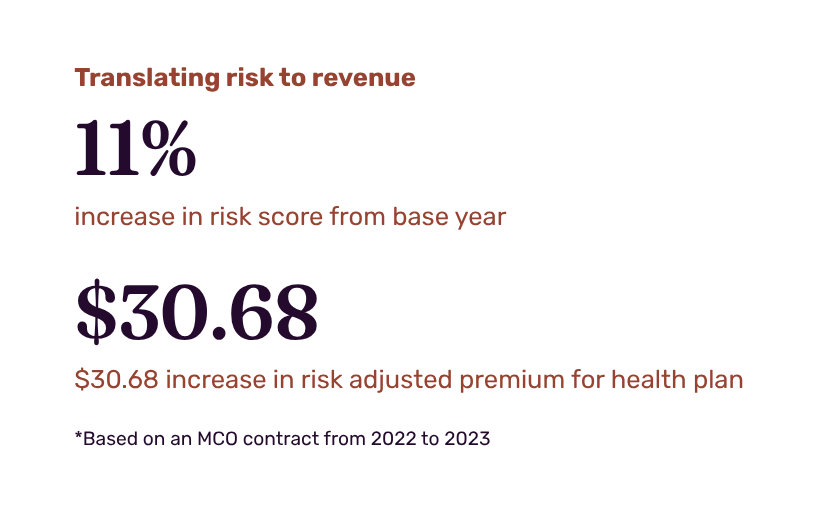
Their work has already translated to an 11% increase in risk score and $30.68 more per member per month for partner health centers. That revenue directly boosts their ability to serve their communities. Yuvo partner, Aizer, saw their risk adjusted premium jump $133.54 per member, per month while decreasing the Medical Expense Ratio (MER) by 2.612% in their Fidelis contract from 2024-2025.
Health centers serve the most complex patients, but their revenue doesn’t always reflect it
According to the National Association of Community Health Centers (NACHC) community health centers (CHCs) now serve over 34 million patients nationwide, including one in five Medicaid enrollees and one in five rural Americans. Nine in ten patients are low-income, and the majority rely on Medicaid or are uninsured, often with higher rates of chronic disease and unmet social needs.
Despite that reach, health centers account for less than 3% of total Medicaid expenditures. That efficiency is remarkable, but it also reflects how little of the system's resources flow their way. In 2024, health centers grew their patient volumes while running at an average operating margin of -2%, according to NACHC.
Health centers are doing the hard work without the compensation to match. As Medicaid cuts loom, that gap in revenue matters more now than ever.
Incomplete coding is one of the problems. For example, a provider might document “obesity” when the patient actually has “Class III obesity” with related complications—a distinction that signals far greater clinical complexity and translates directly to higher reimbursement. Or, they might note a history of depression without capturing its link to a patient’s diabetes management. Conditions may get documented in assessments but never make it to the bill.
The care is there, but the revenue isn’t.
The system makes precise coding difficult
Health centers are being asked to do something detailed and difficult without enough support. Coding guidelines change every year. ICD-10-CM updates take effect each October, shifting which diagnoses map to which Hierarchical Condition Categories (HCCs) and at what risk weight.
Health center providers carry heavy patient loads and want to spend their time talking to their patients, not deciphering coding changes. Plus, they work in EMR systems that are not designed for risk adjustment workflows. They’re simply stretched too thin and significantly under-resourced.
That’s why Yuvo Health is determined to ensure health centers don’t leave money on the table.
How Yuvo Health approaches risk adjustment
Yuvo Health's risk adjustment team works on two fronts: reviewing past visits to surface conditions that were documented but never billed, and building education and workflows that help providers capture the full picture before a patient leaves the room.
"The whole idea is to paint the picture of the exact disease burden of the patient. If the payer doesn't think the patient is as sick, that affects the resources you receive to care for that patient."
— Diedra Mallory, Risk Adjustment Specialist, Yuvo Health
These "documented but not billed" gaps represent real revenue health centers have already earned but are not receiving.
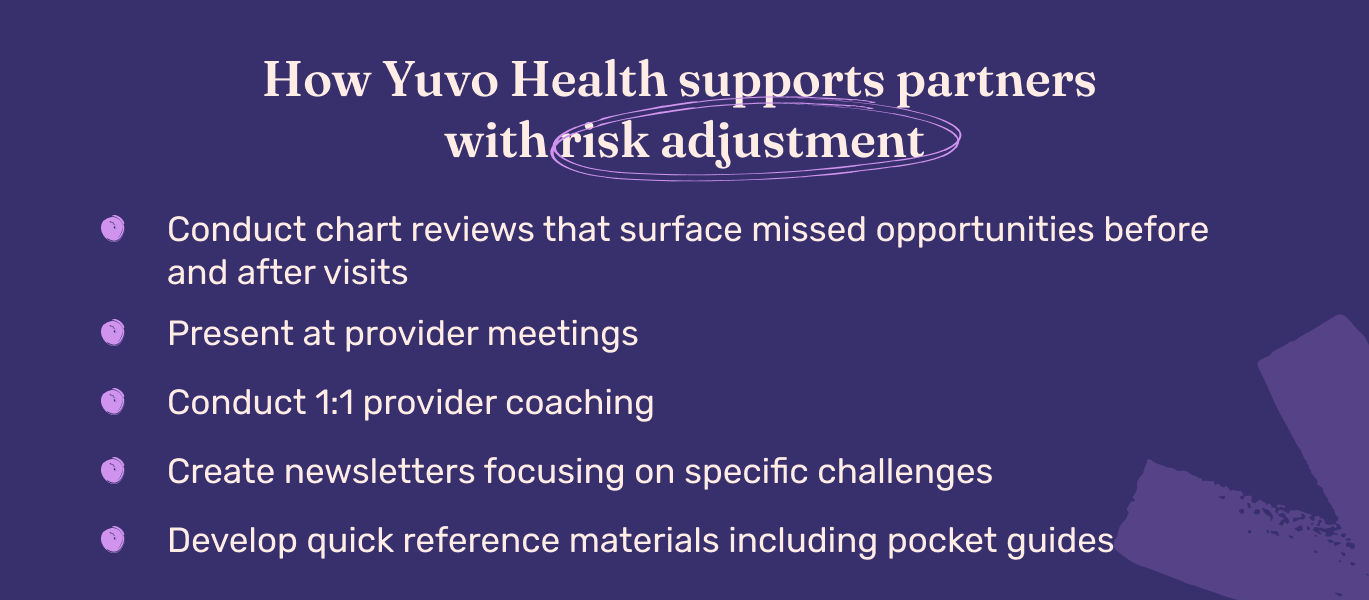
Provider education is at the center of closing them. The Yuvo team works one-on-one with clinicians using real patient examples to show how specific coding decisions affect risk scores and, ultimately, what resources the health center receives to care for that patient. The support is tailored to the specific health center’s needs and can include:
- Conducting chart reviews that surface missed opportunities before and after visits
- Presenting at provider meetings
- Conducting 1:1 provider coaching
- Creating newsletters that focus on specific challenges
- Developing quick-reference materials, including guides small enough to fit into a provider’s jacket pocket
Relationships built on trust
Diedra Mallory, Risk Adjustment Specialist, started her career in patient-facing roles, including inpatient psychiatry, surgery and urgent care, before becoming certified in coding. That background shapes how she approaches the work: not as a billing exercise, but as something that matters for patient care and the sustainability of the health center.
She partners with proponents at the health centers to ensure they can reach everyone who needs more guidance or resources to accurately code in a way that doesn’t feel burdensome.
“Every year, health centers are expected to do more, and there isn't enough time in a day to manage all of these expectations. My job is to provide more strategic and streamlined approaches to their current work without adding anything new to their already-full plates,” Diedra says.
Rachel Leifer, CPC, Coding Manager and Chana Rabinowitz, QI Coordinator and Prevention Team Lead at Aizer, meet virtually with Diedra every month to identify common coding mistakes, individual providers who need more assistance, and other opportunities for improvement.
At Housing Works, providers have dedicated administration time built into their schedules, which Vice President of Health Innovation Naomi Harris Tolson has used to make sure each provider receives the education and coding resources that Diedra offers.
Risk Adjustment Specialist Carita Ebanks knows that she has to show real value if she wants to attract and keep the attention of providers.
She goes into some health centers twice a week to work with providers directly, presenting on topics like distinguishing hypertension with chronic kidney disease from hypertension with chronic kidney disease and heart failure — specific scenarios where the right code makes a real difference.

As Carita explains, the relationships behind this work matter as much as the tools. Early on, buy-in wasn't automatic. She admits her training was sometimes seen as “one more thing to do.” But she was determined to create relationships and show how she could help providers and their patients.
“Now when I come in,” Carita says, “Everyone has a question they want to ask. Everyone is happy to see me.”
One provider posted the resource materials Carita provided on the wall for quick reference. Another keeps a dry erase board with common codes right above her desk.
Translating risk to revenue
Through risk adjustment work, Yuvo Health has helped partner health centers demonstrate measurable results — in the revenue they receive and the quality of care they're able to provide. In one MCO contract, Yuvo helped partner health centers achieve an 11% increase in risk score from base year, translating to a $30.68 increase in risk-adjusted premium per member, per month.
At Aizer, the risk adjusted premium increased $133.54 per member, per month. During the same period, the medical expense ratio (MER), the share of premium dollars spent on patient care, dropped by 2.61%, indicating care is becoming more proactive and efficient.
This is revenue health centers need especially now as Medicaid cuts stretch their budgets even further. More than plugging short-term gaps, this reliable funding allows partners to build toward greater stability by reinvesting into staffing, systems and services. For example, leadership at one health center plans to hire someone dedicated to pre-visit planning—a move that would create a cycle of better coding, fewer care gaps and more revenue.
The clinical impact is equally real. When Yuvo helps a health center capture a patient's full picture, for example the link between their diabetes and depression coded or their housing instability noted, every provider who sees that patient is better equipped to act.
Better coding also opens doors for patients directly: someone coded for morbid obesity rather than "overweight" may qualify for nutritional counseling or other resources they'd otherwise miss.
Looking ahead: social needs and the future of risk adjustment
ICD-10-CM Z codes capture non-medical factors like housing instability, food insecurity and lack of transportation that affect a patient’s health. For years they carried no direct reimbursement, but that is beginning to change in some states. New York’s 1115 Medicaid Waiver, approved by CMS in January 2024, integrates social care into the Medicaid program through regional Social Care Networks (SCNs). As the state’s value-based payment framework evolves to account for social complexity, health centers already screening for and documenting social needs stand to see those efforts recognized in risk-adjusted payments down the road. That’s why Yuvo aims to screen 40,000 people for unmet social needs through a partnership with Public Health Solutions and Hyphen.
“It’s huge. Capturing social needs can both identify things standing in the way of better clinical care and increase the risk score. In turn, that supports bringing down the ratio of costs incurred for the care of that patient compared to the premium received.”
- Cassie Parks, Director of Care Management and Patient Engagement, Yuvo Health
Health centers have always understood that housing and food are as much a part of their patients’ health as blood pressure and hemoglobin A1C. Risk adjustment is slowly catching up to that reality. With the right documentation practices in place today and a record of accurate data to support their impact, health centers can be ready when the payment system fully recognizes it.
Risk adjustment isn’t a separate program or an add-on service. It’s a foundational piece of value-based care and one of the clearest examples of why health centers benefit from a dedicated partner who understands their unique challenges and is invested in their success. Every dollar recovered through more accurate coding is a resource that can go back to the community.


Subscribe to our monthly newsletter just for community health centers
We’ll send occasional emails with Yuvo and FQHC news.